


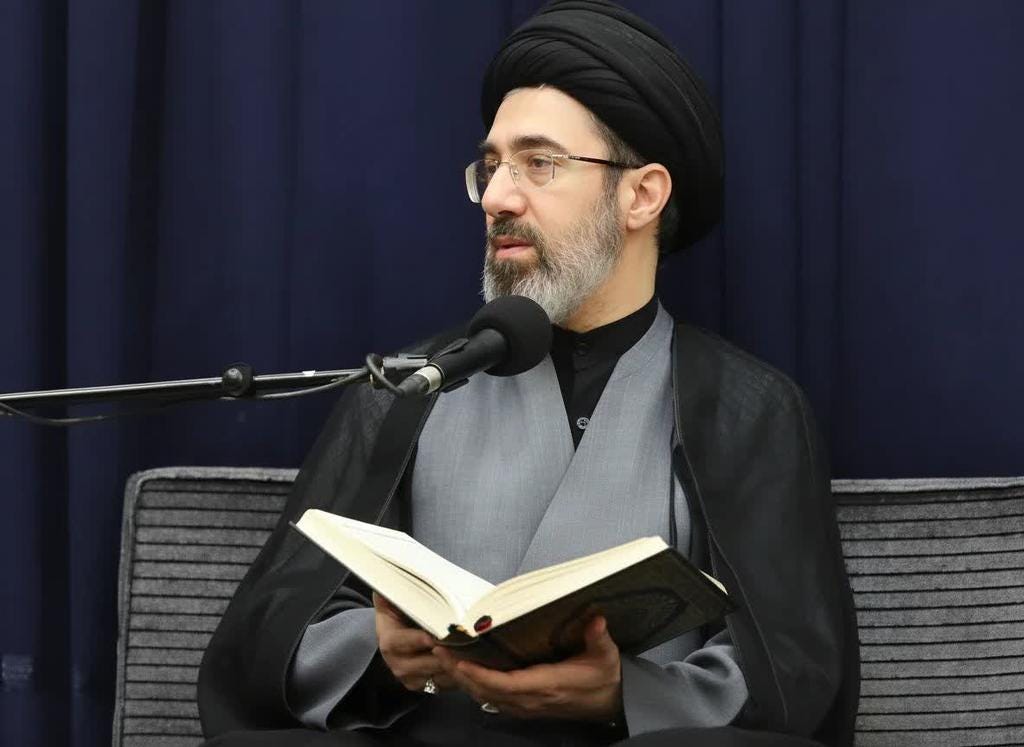
Four days after the Islamic Republic announced Mojtaba Khamenei as its new supreme leader, the Iranian public still has not seen him. He has entered office without appearing on camera, and many Iranians have never even heard his voice. His first message to the country came not as a speech, but as a written text.
That is striking. In the Islamic Republic, power is usually shown, not just declared. A new leader is expected to appear, speak, and project control. The choice to release a text instead of a video suggests a regime deeply worried about its new leader’s safety. If the system believed Mojtaba could appear without serious risk, it would almost certainly have shown him. Instead, it kept him off screen.
A Script of Defiance
The message itself offers no sign of de-escalation. It does not try to calm the country or lower tensions. It is a message of clear continuity. Mojtaba calls for “effective and punishing defence.” He says “the lever of closing the Strait of Hormuz must be used.” He also says plans have been prepared for opening “other fronts” where the enemy is weak and exposed. This is an open threat to widen the conflict if the war continues.
His language on Iran’s regional allies is just as direct. He presents the “resistance front” as part of the core values of the revolution, not as a side issue or a temporary policy. The message does not sound like that of a leader looking for a way out. It sounds like the language of continuation.
That matters because the path taken by Ali Khamenei brought a devastating war to Iran. Mojtaba’s first message suggests he is not trying to change course. He is embracing the same line: escalation, proxy warfare and regional confrontation.
The Clerical Face of the IRGC
The most important question raised by the text is whether Mojtaba is leading the Islamic Revolutionary Guard Corps, or whether the IRGC is leading him. On revenge, Hormuz, regional pressure, and pressure on neighbouring states, his language is almost identical to the line the security state has been pushing.
That suggests the succession has not created a new centre of power. It may simply have confirmed that real power already sits with the security apparatus, and that Mojtaba is now its clerical face.
By taking such a hard line so early, Mojtaba is making himself more exposed. He is presenting himself as the next leader of the war, not as a cautious successor. That makes it easier for Israel to see him as part of the same chain of command, and therefore as a possible target.
Fear and Denial
The text also shows clear fear at home. One of its most important passages says that if the people’s power does not “appear in the scene”, neither the leadership nor state institutions will work properly. It then calls for “effective presence in the scene” in social, political, cultural, and even security fields.
This is a strong sign that the leadership fears a mass uprising. The regime wants to fill public space with its own supporters, leaving no room for dissent. He does not openly threaten protesters in this passage, but the message is clear enough.
Mojtaba also makes an unconvincing attempt to distance himself from the succession process. He says he learned of his appointment through the state broadcaster at the same time as the public. The point of this line is obvious. He is trying to suggest that he did not seek the role and was not part of the process. But the claim only draws more attention to the long-running reports that he had been prepared for this position for years.
His mention of seeing his father’s body also matters. It appears designed to show that he is present, functioning, and close to the centre of power. At a moment when the public still has not seen him, even small details like that do political work.
The Style of the Writing
The style of the text is revealing too. It does not read like modern Persian political writing. It reads like old clerical prose: heavy, formal, full of religious language and often awkward in structure. The opening is packed with invocations, mourning formulas, and Quranic language before it gets to the political point.
Even when the message is simple, the writing tries hard to sound grand. It uses heavy phrases and tired formulas that belong more to seminary and official-state writing than to modern public language.
That matters because the content itself is simple. The message is: keep fighting, stay loyal, punish the enemy, and hold the street. But the language makes even these basic points sound stiff and old. Many ordinary readers would find the prose harder than the ideas.
This is one reason some people believe the text may really be his, or at least close to his own style. It does not read like the work of a polished modern speechwriter trying to reach a wide public. It reads like clerical writing: overblown, old-fashioned, and shaped by seminary language.
No New Path
The message ends as aggressively as it begins. On neighbouring states that host US bases, Mojtaba warns that Iran will continue strikes if needed and says those countries should shut down those bases as soon as possible. On compensation, he says Iran will take compensation from its enemies, and adds that if payment is refused, it will take from their assets or destroy their property.
In the end, the importance of this message lies in the contrast between its form and its content. The form, a written text instead of a speech, shows a regime acting out of fear. The content shows a leader offering no new path.
Mojtaba appears not as a leader trying to redefine a system in crisis, but as the clerical face of a security state that has already pushed Iran to the edge.
Thank you for this insight Mehdi !
I like your analysis of the text, its tone and its context.
I like reading Mehdi P.’s essays. I agree with his characterization of the so-called proclamation from the “Il-Duce, Grand Ayatollah Mojtaba”. The writing, I too found awkward. As an Iranian with a penchant for simple Persian devoid of Arabic words, I found the Mojtaba diatribe unintelligible These Islamic clergy from Iran are a species onto themselves. An anachronistic phenomenon that simply must be eradicated—Lock, stock and barrel. Their ideas and if necessary, their persons. These people cannot be reasoned with. They are medieval creatures that somehow in their Jurassic Park that the late Shah did not undertake to destroy multiplied. That Jurassic Park must be destroyed and its remains turned into a nature sanctuary.