


The argument about Iran’s opposition usually starts with a familiar complaint: it is too fragmented to win. The prescription follows automatically: unite first, then act. But that diagnosis is colliding with what the streets have shown in the past year. Millions have moved in synchronised waves without a committee, a charter, or an organisational chart. The problem is not a lack of unity. It is that Iran’s opposition is divided by incompatible end-states, while the street is already converging on a focal point.
On 8–9 January 2026, Iran saw mass demonstrations in more than 400 cities, according to official Iranian figures. The regime responded with an unprecedented massacre. Iranian authorities have said more than 3,000 were killed. Other estimates are far higher, putting the death toll as high as 40,000.
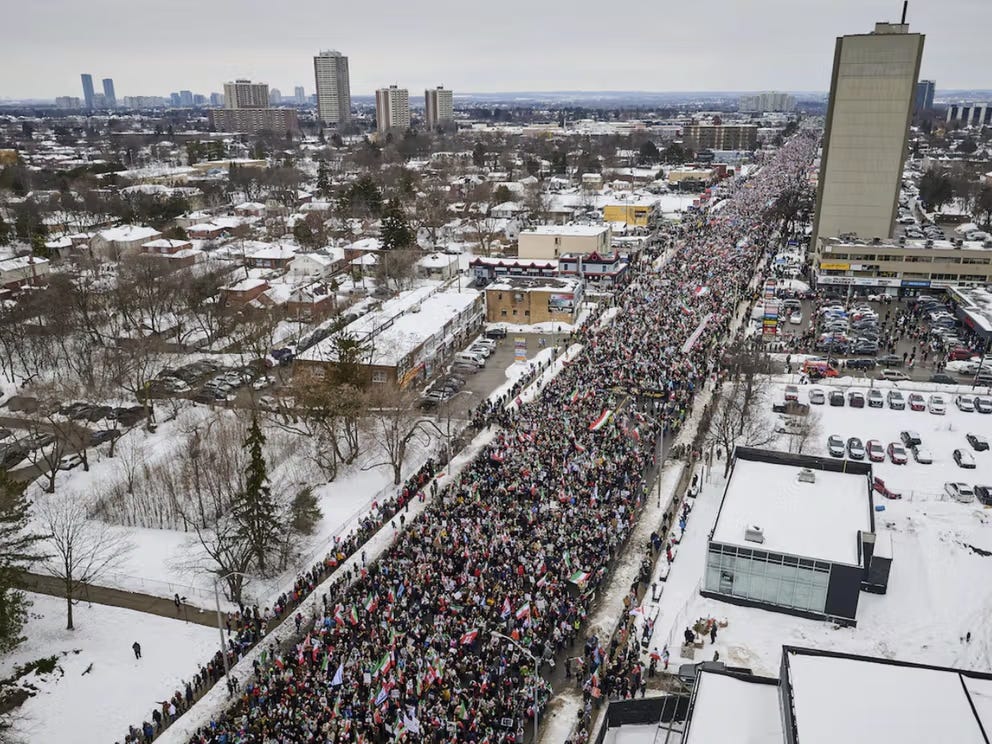
Afterwards, Iranians abroad mobilised in major cities around the world. This included large rallies on 14 February in Munich, Toronto, and Los Angeles. Local police estimated the combined turnout across the three cities at close to one million.
What matters here is not only the scale, but how it happened. The call to action did not come from a committee room in Europe or from a “Unity Charter” signed by exiles in a hotel ballroom. It came from a single source. And when it arrived, the response looked less like a political debate and more like a physical force: a rhythmic thud of feet on pavement, from the religious heartlands of Qom and Mashhad to Tehran and hundreds of other cities inside Iran, and then across borders to hundreds of cities around the world.
As the streets filled again, the slogans became sharply clear. People were not asking for a “grand coalition” or an “ideal republic”. They were chanting a name that, for 40 years, was meant to stay in the past: Prince Reza Pahlavi.
Against this backdrop, a familiar claim keeps appearing in Western publications and think-tank circles: the Iranian opposition is too fragmented, and so it must first form a unified movement before it can win. This is often presented as common sense. But what is happening on the ground points to a paradox. The same people described as “fragmented” have repeatedly moved in frighteningly efficient unison. What may be missing is not unity itself, but a specific, bureaucratic kind of unity; one that looks like a committee, a charter, and a neat organisational chart.
When you force a revolution into a committee-shaped template, you risk slowing the only thing that is moving.
This mismatch is not just about words. It shapes strategy. It shapes expectations. And it can slow momentum if it forces a revolution into a committee-shaped template, while the street is creating alignment through a different logic.
The effort to “unite” the opposition is not new. It has been tried for two decades with little to show for it. Bringing it back now, when millions are moving, is not a revolutionary idea. It can become a counter-revolutionary force, because it pressures the movement to slow down to conform to an outside image of what revolutions are “supposed” to look like.
The Three Arenas: A Map of Incompatibility
To understand why the “unified movement” mantra so often fails, it helps to map the landscape as it is, not as people may wish it was. This is not a flat field of people who simply need to “get along”. It is three arenas, each with its own logic.
The opposition to the system: the core of the struggle, dominated by two main constitutional end-states, a Republic and a Monarchy, and surrounded by ethnic and regional parties and Federalist projects whose local grievances do not map neatly onto the national debate.
The opposition inside the system: those who still believe change can happen by reforming the existing order from within.
The sub-factions: splinters of left and right, secular and religious, liberal and nationalist, and individuals who may belong to one of the currents above but also carry personal weight because they are Nobel laureates, prominent intellectuals, or well-known celebrities; singers, actors, athletes, and others.
This is often described as “fragmentation”. But fragmentation is not the core problem. Incompatibility is.
Trying to fuse republic and monarchy into a single “project” is not a mature compromise. It is a logical and historical absurdity. One system was destroyed in 1979 to create the other. These are not two versions of the same destination. They are opposite answers to a basic question of sovereignty: who embodies the state, and how is authority legitimised?
“The problem is not fragmentation. The problem is incompatibility.”
A third current, federalism, is popular among some ethnic minorities. It can be strong in regional politics, but is unlikely to become a dominant national end-state. Federalism is widely unacceptable to both republicans and monarchists. That means it cannot serve as a bridge between the two main poles.
This is why unity initiatives repeatedly collapse when they meet reality. A charter can list shared values such as human rights, territorial integrity, democracy, and dignity. But it cannot solve monarchy versus republic versus federalism without either avoiding the issue or collapsing into word games.
This is where the usual workaround appears: “Unite first to remove the regime; decide later.” But in Iran, “later” is not neutral. The transition will be shaped by who the public sees as the face of the movement during the struggle. Visibility becomes leverage. And there is another reality today: the Pahlavi current is far ahead in commanding the streets.
Crucially, Reza Pahlavi is not a free agent. He must answer to a large, passionate base, and he cannot simply take a step his supporters reject. That base, especially Gen Z, brings its own version of “cancel culture” into politics. It strongly rejects any sign of co-operation with people it sees as complicit in the country’s ruin under the Islamic Republic. His supporters dislike many of the figures that analysts want him to work with. They have a name for that political lineage: the “57-ers”. Bringing those figures into one room effectively asks the monarchist camp to share its street momentum with partners who do not have it, at least for now.
At the same time, for other factions — republicans and federalists who currently have the weaker hand, sitting with him would look like an endorsement. That is why a “unity table” becomes politically toxic for everyone who sits at it.
The Knot of 1979: The Original Sin and Why “Unity” Triggers Alarm
Conflicting end-states are only part of the story. A second force shapes opposition politics even more deeply: the unresolved legacy of the 1979 revolution (1357 in Iran’s calendar). Gen Z has a name for that political lineage: the “57-ers” (panjah-o-hafti).
In a landscape sharpened by Woman, Life, Freedom, and protest cycles extending into 2026, “57-er” has become more than a demographic label. It is a moral and political judgement on those seen as complicit in launching the revolution and in the catastrophe that followed. The term has broken free from chronology. It does not simply mean people who were adults in 1979. It targets a mindset and a lineage: people linked to bringing the Islamic Republic into being, and those who later helped keep it socially and intellectually survivable.
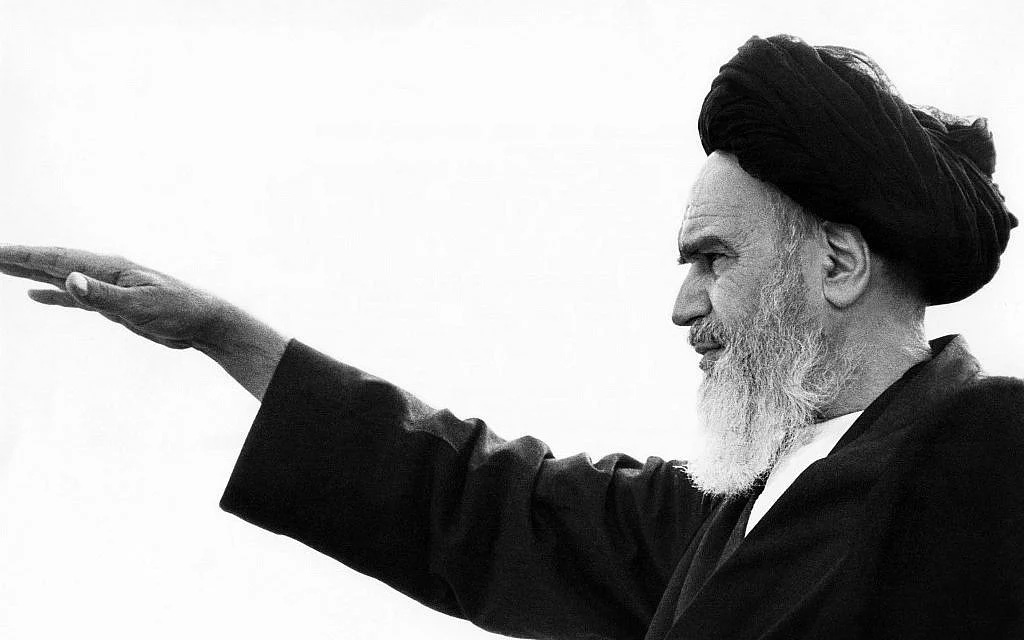
In 1979, many of the currents that today call themselves republican or reformist lined up behind Ayatollah Ruhollah Khomeini. They did not form a formal coalition, but they did create an unofficial united front against the Shah, rallying under Khomeini’s hegemonic leadership and street power. For many Iranians today, that is the original “unity” that ended in disaster. That is why “57-er” has become a broad label of blame. It is also why calls for inclusive unity can trigger contempt, because they can look like a return to the same kind of unity that helped deliver the country into the Islamic Republic.
It usually points to two overlapping groups:
The original enablers: the Islamists who followed Khomeini, the leftists who imagined an anti-imperialist breakthrough, and the nationalists who believed the clerics would fade back into the mosques.
The sustainers and polishers: post-revolution figures, including some ageing reformists and some diaspora intellectuals, who claim opposition credentials but defend the 1357 legacy through appeals to gradualism, “dialogue”, or the regime’s own constitution.
“In 1979, many currents rallied under Khomeini in an unofficial united front. For many today, that is the unity that ended in disaster.”
For today’s activists, calls for “inclusive fronts” with figures tied to that lineage smell like the start of another hijacking. This is the root of the street’s “cancel culture”, a defensive mechanism against a repeat of 1357.
In this view, the “57-er” mindset puts ideology ahead of national interest and what many young people call a “normal life”. It explains Iran’s crisis mainly as an external struggle, shaped by anti-imperialism, pro-Palestinian politics, anti-Western positioning, or an Islam-centred worldview. For many young people, this is a failed model. Legitimacy now comes from visible rupture and visible cost, and from rejecting everything linked to the 1979 revolution. In that atmosphere, “unity” does not sound like pragmatism. It sounds like contamination.
The Lethality Gap: Why the Moral Maths Has Changed
This helps explain a question that puzzles outside observers: how can a generation that never lived under monarchy chant for its return? Part of the answer is not nostalgia. It is comparison.
The story of the “repressive monarchy” was the moral fuel of 1357. But today’s youth grew up with a state that treats dissent as treason. This is where numbers matter. Emad al-Din Baghi, an Iranian researcher and human rights writer, drawing on records of those counted as “martyrs” of the anti-Shah movement, put the total killed between 1963 and 1979 at 3,164.
“Today’s baseline is a state that kills on a scale that rewrites the moral comparison with the past.”
Against that baseline, the belief that the Islamic Republic can kill, in a single day, on a scale the previous era never reached, such as the 3,000-plus killed in early January 2026, becomes politically decisive. Many young protesters draw a blunt conclusion: whatever the Shah was, this is worse. Pahlavi returns not only as a name but also as shorthand for the total rejection of the 1357 inheritance and a return to national normalcy.
The Reverse-Engineering Trap
While the street is moving towards a focal point, policy circles keep trying to reverse-engineer a revolution using the Gene Sharp template. Sharp’s theories of non-violent struggle, which have influenced a generation of Western diplomats, argue that a “unified centre of gravity” is required for success.
Analysts treat this committee-shaped unity as the goal. But in Iran, it can act as a brake. It asks the only vehicle currently moving to slow down so others can catch up, not mainly to strengthen the revolution, but to produce an administrative object that foreign capitals can recognise. For the rising pole, unity begins to look like dilution. For lower currents, it appears to be absorption. This does not help a revolution. It is a kind of reverse-engineering that weakens the strongest force for mobilisation.
Conclusion: The Goal Is Victory, Not Harmony
Iran’s streets have already spoken. The call for a “unified movement” belongs to an earlier phase, when no pole had momentum. Now that momentum exists, demanding unity-as-merger is not neutral. In Iran today, it is a call to pause.
The focus should shift from identity to process: Will there be a referendum? What rules will govern the transition? If outsiders want to help, they should stop trying to build umbrellas for people who are already standing in the sun. The goal is not to make Iran’s opposition “one”. That is neither possible, necessary, nor useful. The goal is to make the transition safe, and to stop using committee-shaped fantasies to misread a revolution being built in real time, under fire.
Nice article. The 'unity-as-merger' frame has always been more about making the opposition legible to Western policy circles than about winning. What should the diaspora do once they stop fighting over who leads?
Enjoyed reading your piece. Well argued. اخوند، مجاهد و چپی+ جبهه ملی پیر وپاتالها انقلاب ۱۳۵۷ را مدیریت کردند. انها ذاتشان با نام « پهلوی»
در تضاد نا پایان است.
انها را بازی نگیریم که مبادا بزرگ شوند.
انها مبتلا به بیماری نیمه سوادی روشنفکران ایرانی دهه های ۳۰، ۴۰ و ۵۰ بودند:
ادعاهای بزرگ اما با صفر میزان مسئولیت در قبال ان ادعا.
روش مبارزه با انها زندان و کشتار انها نیست. بلکه کشیدنشان به دادگاه ای عمومی برای افترا و دروغ و در صورت گناهکار شدن، نه زندان، بلکه جریمه های بالای نقدی.
Hit them in their pocket books.