


Mohsen Rezaei, Iran’s new secretary of the Supreme National Security Council and a former commander-in-chief of the Islamic Revolutionary Guard Corps (IRGC), says the Strait of Hormuz will remain closed until the United States accepts Tehran’s conditions.
Those conditions go well beyond ending the US maritime blockade. Rezaei says Washington must end the war, release Iran’s frozen funds and bring conflicts across the region, including in Lebanon and Gaza, to an end. Other demands, he says, have been communicated through mediators.
His comments help explain two developments in Tehran: the power structure taking shape below Mojtaba Khamenei, and how the security officials emerging at the center of that structure see the confrontation with the United States.1
A power pyramid is emerging
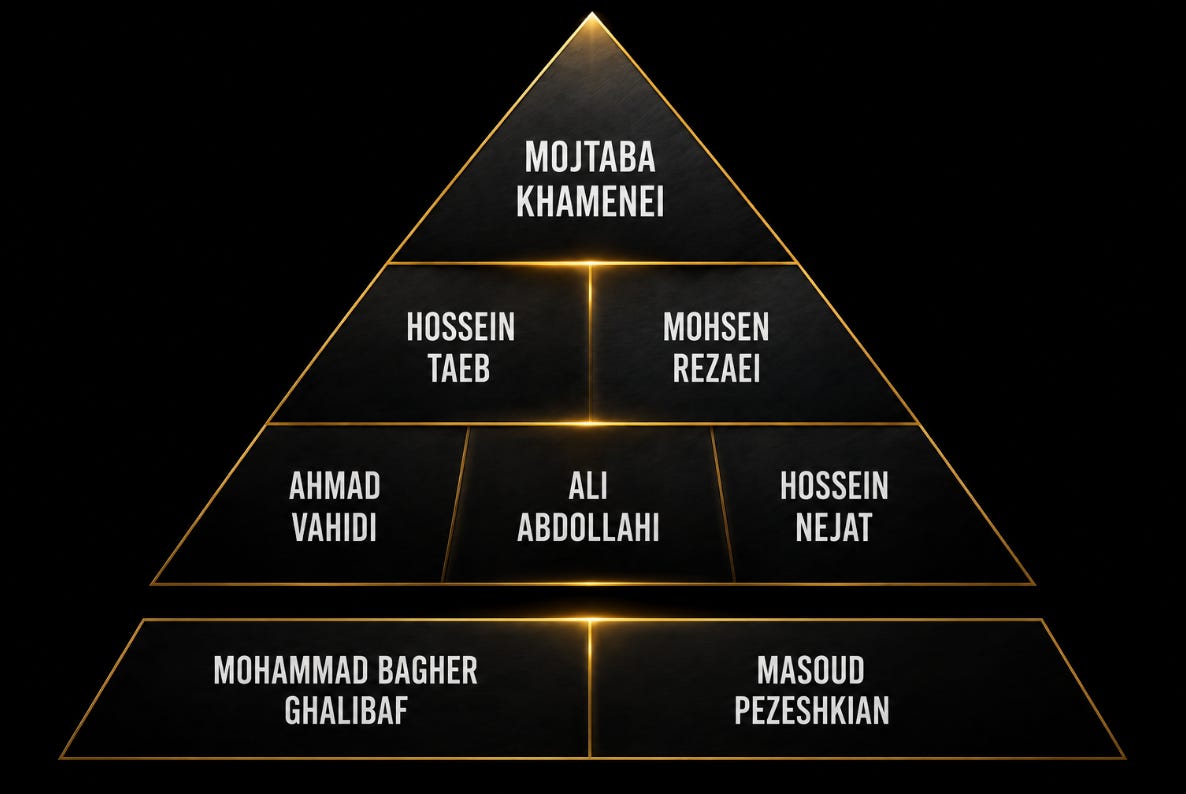
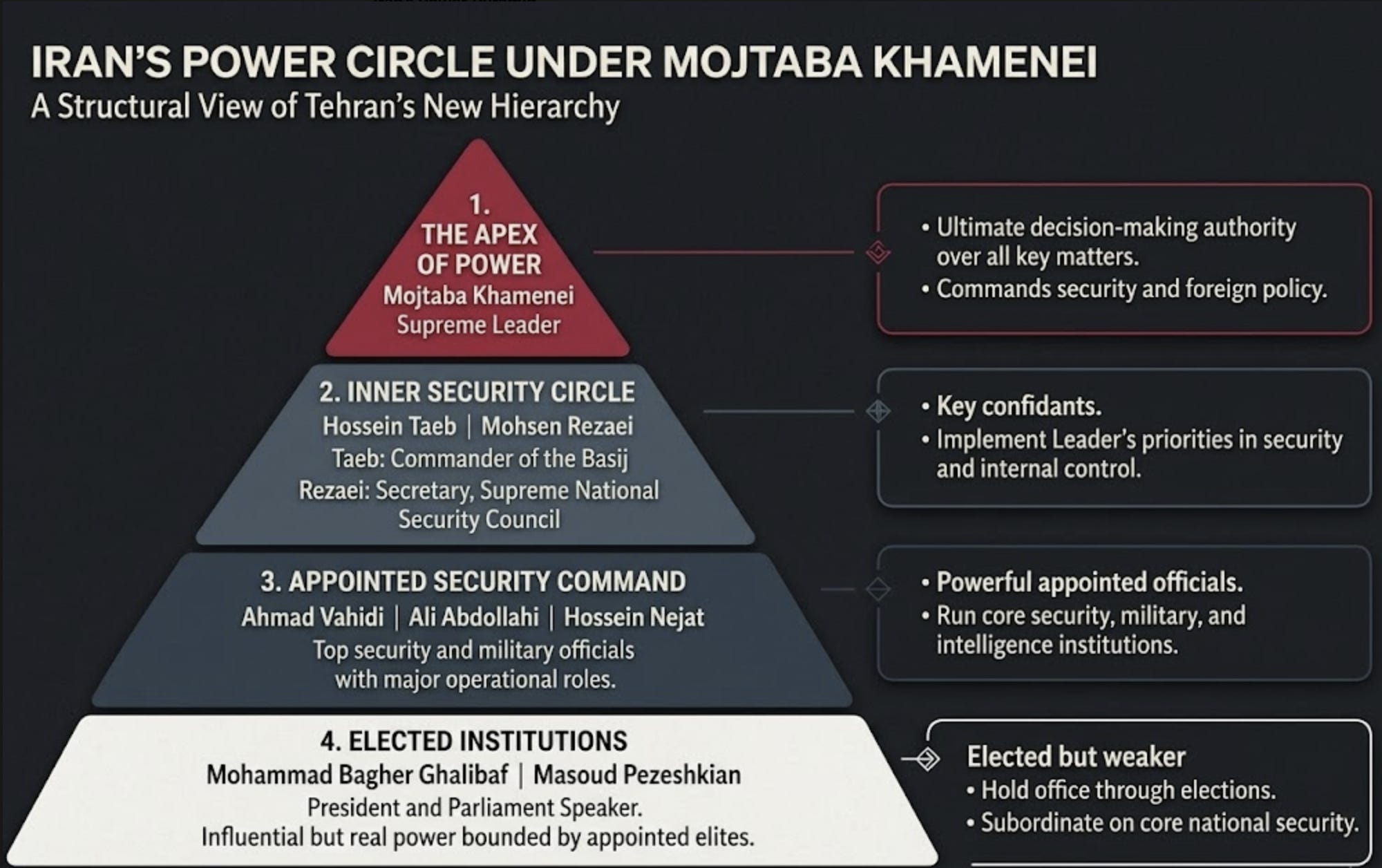
What has been less clear since Ali Khamenei’s death is the distribution of power below his successor. For a period, the layer immediately beneath Mojtaba Khamenei appeared unusually flat. It was difficult to tell who carried more weight among Mohammad Bagher Ghalibaf, Ahmad Vahidi, Mohammad Bagher Zolghadr, Ali Abdollahi and other senior political and security officials.
That picture is becoming clearer. Hossein Taeb and Mohsen Rezaei now appear to be the two most important figures immediately below Mojtaba. Taeb, the new commander of the Basij and former head of IRGC Intelligence, is one of Mojtaba’s oldest confidants. He now controls an organization central to suppressing domestic unrest at a time when its intelligence powers are also being expanded. Rezaei, meanwhile, now holds one of the most important positions in Iran’s national security system.
Below them are powerful appointed officials, including Ahmad Vahidi, commander-in-chief of the IRGC; Ali Abdollahi, chief of staff of Iran’s armed forces; and Hossein Nejat, commander of the IRGC’s Tharallah Headquarters in Tehran. Ghalibaf’s position is harder to place. His network remains influential, and Abdollahi is a longtime associate, but Ghalibaf’s personal standing appears weaker than it did several months ago.
There is also an important institutional divide. Ghalibaf, Iran’s parliament speaker, and Masoud Pezeshkian, Iran’s president, hold elected office. Taeb, Rezaei, Vahidi, Abdollahi and Nejat are appointed officials. In the Islamic Republic, appointed positions tied to the supreme leader and the security establishment have traditionally carried more power than elected offices.
This hierarchy should not be seen as fixed. Iran’s political system remains fluid, and more information in the coming weeks and months may change our understanding of where individual figures stand. What can be said with more confidence now is that the picture is considerably clearer than it was immediately after Ali Khamenei’s death. The structure below Mojtaba no longer looks flat, and a more recognizable power pyramid is beginning to emerge.
There is also a longer history to keep in mind. The senior figures around the center of power in the Islamic Republic have often been the same people, moving between different posts over many years. What has changed is their influence and their proximity to the supreme leader. A figure could be powerful at one moment, pushed towards the margins at another, and later brought back into the inner circle.
Ali Khamenei used this constant reshuffling as a way of managing the system. He rarely allowed any one figure or network below him to become powerful enough to develop an independent center of authority. By moving officials between positions, promoting some and reducing the influence of others, he maintained a balance between competing networks while keeping himself at the center.
Mojtaba Khamenei is a product of that political system and learned politics under his father. If Ali Khamenei’s method is any guide, the pyramid now taking shape should therefore be understood as a snapshot rather than a permanent order. Taeb and Rezaei may currently be closest to the center, but their relative influence can rise or fall as Mojtaba manages the people and networks around him.
That fluidity does not make the emerging hierarchy less significant. It helps explain how power has traditionally worked in the Islamic Republic: the cast changes very little, but their distance from the center of power changes constantly.
The dispute behind Rezaei’s rise
Rezaei’s appointment followed a serious dispute over Iran’s negotiations with Washington. A memorandum negotiated between Ghalibaf and JD Vance, the US vice president, and later signed by the Iranian and American presidents, triggered a backlash among supporters of the Islamic Republic. Ghalibaf and Pezeshkian were accused of crossing lines set by Mojtaba Khamenei.
In his first written message as supreme leader, Mojtaba had demanded compensation from Iran’s enemies and said Tehran should continue to use the closure of Hormuz as leverage.
“We will extract compensation from the enemy, and if they refuse, we will seize as much of their assets as we deem appropriate. If that is not possible, we will destroy an equivalent amount of their assets.”
Mojtaba Khamenei
Critics argued that Ghalibaf and Pezeshkian had no authority to agree to a process that could reopen the strait without first securing Iran’s demands. Their defense was that the Supreme National Security Council had approved the agreement. Mojtaba later intervened, saying that, “in principle,” he had held a different view of the agreement. But he said he had authorized it after Pezeshkian gave assurances that Iran’s rights and those of what Tehran calls the “Resistance Front” would be protected.
Rezaei had taken a harder position throughout the dispute. He repeatedly appeared on Iranian television opposing a settlement that did not meet Iran’s demands. He called for revenge for the killing of Ali Khamenei, whom officials describe as the “martyred leader”, the withdrawal of US forces from the region, compensation for the damage caused by the war, and permanent Iranian control over the Strait of Hormuz, including the right to charge vessels for passage. Soon afterwards, he became secretary of the Supreme National Security Council.
This does not prove that his predecessor was removed because of the disagreement. But the outcome is significant. One of the most visible advocates of a harder approach now sits at the center of Iran’s national security decision-making.
Hormuz and Tehran’s calculation
Rezaei’s latest comments show that Tehran’s calculation over Hormuz has hardened. Previously, reopening the strait was linked mainly to ending the maritime blockade and, at times, securing a ceasefire in Lebanon. Tehran is now connecting it to a much wider set of demands.
Hormuz is no longer simply a bargaining chip for a specific American concession. Tehran increasingly sees it as a way to widen the economic costs of the conflict and offset some of the military advantages of the United States and Israel. As some IRGC-aligned analysts put it, Iran has turned a military war against itself into an economic problem for the wider world.
This thinking also shapes how they see the current calm. They do not believe the war is over, but rather that the United States and Israel may return to military action. Their concern is that a temporary agreement could allow President Donald Trump to calm energy markets and ease economic pressure at home before the US midterm elections, while preserving the option of returning to war later.
This explains the intense attention Iranian state media and IRGC-aligned analysts pay to global oil markets, US petrol prices, and American inflation. Even relatively small price movements are examined for signs of how economic pressure might affect US public opinion. From their perspective, giving up Hormuz now would not only surrender Iran’s main source of economic leverage. It could also help Trump at the moment Tehran believes he is most politically vulnerable.
But there is a striking blind spot in this calculation. While these analysts closely monitor relatively small changes in American prices, they pay far less attention to the much greater economic pressure inside Iran. Annual inflation has reportedly reached about 62%, while food inflation in July reached 134%. Cooking oil prices were up 261% and meat 145%. For Iranian households, this represents a severe loss of purchasing power.
Tehran’s strategy therefore rests on a major assumption: that Iran’s economy and population can withstand prolonged pressure longer than global energy markets and American voters can absorb the costs of disrupted energy supplies.
That assumption could prove wrong. Tehran may be trying to exploit Washington’s political timetable, only to find that economic and social pressure at home becomes a serious threat first.
The risk of another war
There is another weakness in Tehran’s strategy. Iran wants to play a long game while also preparing for another military confrontation.
Analysts close to the IRGC point to cooperation between the IRGC Navy and the IRGC Aerospace Force in Hormuz. They say shore-to-sea missile attacks on commercial vessels serve two purposes: enforcing the closure of the strait and rehearsing for possible attacks on US naval forces involved in the maritime blockade. The aim, they say, is to improve targeting, missile tactics and coordination so Iran can impose much greater costs if another round of fighting begins.
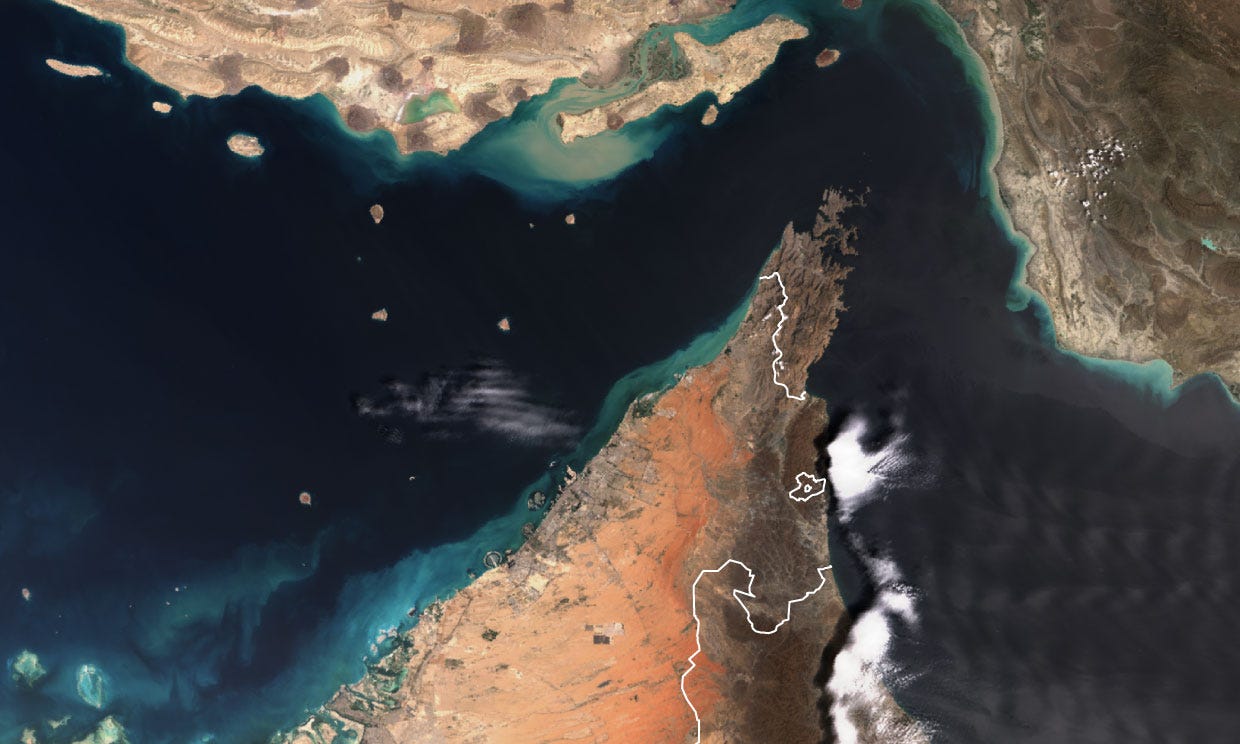
But this creates a serious risk. Military operations around one of the world’s most important shipping routes can move much faster than political strategy. A misidentified vessel, unexpected casualties, or a direct exchange with US forces could turn Tehran’s slow strategy into a major confrontation within hours.
Iran therefore has to maintain a difficult balance: enough pressure to disrupt shipping and impose economic costs, but not enough to trigger the wider war it is trying to postpone or deter. The current calm, in this worldview, is not peace. It is preparation. But the preparation itself could bring the next war forward.
Continuity, not change
None of this means Iran will refuse to negotiate. Tehran may make deals, accept temporary compromises or change tactics when circumstances require it. But tactical flexibility should not be confused with a change in the worldview of the people now emerging directly below Mojtaba Khamenei.
Rezaei, Taeb and the other senior security officials come from the same political and ideological establishment that shaped the Islamic Republic under Ali Khamenei. Their basic assumptions about the United States, Israel, the Resistance Front and Iran’s role in the region have not fundamentally changed.
This is important because much of Iran’s senior leadership has changed through war and assassination. New people are occupying powerful positions, but they are being drawn from the same old security establishment. What is changing is the hierarchy: Taeb and Rezaei appear to be moving closer to the center, Ghalibaf’s relative position appears weaker, and appointed security officials are again emerging above elected politicians in the distribution of real power.
What is not clearly changing is the worldview behind Iranian policy. Deals with Washington may come. Tactics may change. Iran may compromise when it believes circumstances require it. But the emerging power structure gives little reason to expect a fundamental change in Tehran’s approach to the United States, Israel, or the region.
The pyramid is becoming clearer. The ideology behind it remains much the same.
This analysis assumes that Mojtaba Khamenei is alive and exercising authority as supreme leader. There has been no visual or audio confirmation of this. But recent appointments, particularly Hossein Taeb’s return to command the Basij and Rezaei’s elevation, provide some of the strongest indications so far that Mojtaba is alive and making key decisions.
Except these are the 3rd tier rookie bench.
To predict Iran you only have to look at the probability of the statistics.
Just before the Shah's government collapsed we saw Amouzegar hand off to Sharif-Emami, who handed off to Gen. Azhari, who handed off the Bakhtiar.
That's the 4 levels of leadership befoye the collapse.
If this pattern follows (and why wouldn't it?) these idiots are the 3rd tier of the Islamic Republic, right before the final 4th tier, which portends the immediate collapse.
Therefore the US-Israeli campaign of decapitation works. Or was working. What is proven is that stopping it has been a mistake.
Great piece. Really helps explain what’s actually happening.