


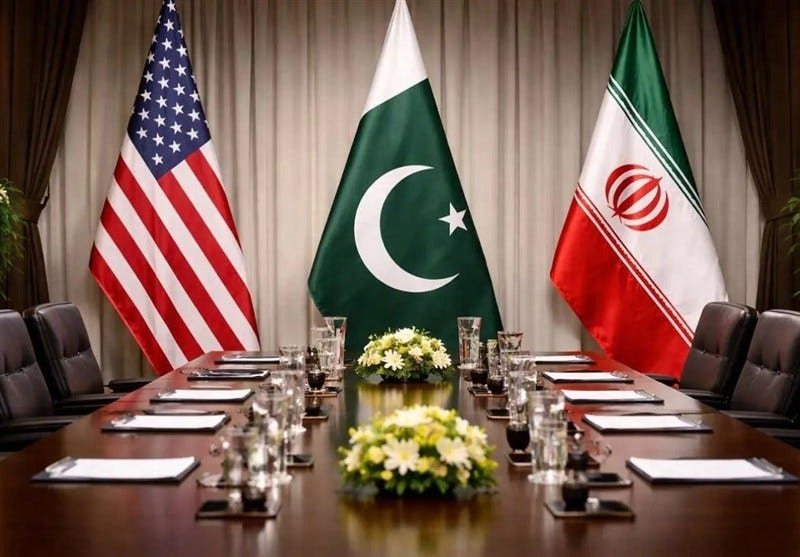
It is not a secret. Listen to IRGC-affiliated analysts over the past year, and you hear the same names again and again. JD Vance. Tucker Carlson. Marjorie Taylor Greene. In their world, these are not just American politicians or media figures. They are signs. They are clues to the internal struggle in Washington. They are proof, or what passes for proof in Tehran, that not everyone in America wanted war with Iran.
Take Mehdi Kharratian. He presents himself as an independent analyst and the founder of the “Institute for Revival of Politics.” He also happens to be the son of Rear Admiral Ali Akbar Kharratian, deputy commander for joint operations of the IRGC Navy. He is obsessed with JD Vance. So are many others like him.
Much of what they say is conspiracy theory and not worth quoting. But one point matters. They believe that if the Islamic Republic had negotiated with JD Vance instead of Steve Witkoff, the war might not have happened. That belief is important, whether or not it is true. It tells us how they read Washington. They think this administration is divided on Iran. They think one camp pushed the United States into war and won. They think another camp wanted restraint and lost. In their minds, Vance belongs to that second camp.
Whether Tehran chose who should speak to it, or whether the administration made that choice on its own, is beside the point. What matters is that Tehran thinks Vance is the better channel.
To be honest, I think it is a good thing that he will be in the room in Islamabad. Let him see it for himself. Let him hear the tone. Let him watch the method. The Islamic Republic is one of those subjects on which Western politicians arrive with theories and leave with experience.
“What matters is that Tehran thinks Vance is the better channel.”
The belief that “I know how to deal with Iran” has haunted the White House for decades. Every administration comes in thinking the last one failed because it did not understand the regime. Every new team thinks it has finally found the right language, the right balance, the right people, the right opening. Every one of them learns the same lesson the hard way. The problem is never just the method. The problem is the nature of the Islamic Republic itself.
Iran may never again find an American negotiator more sympathetic to “understanding” it than Rob Malley. We all saw how successful that turned out to be. Now Tehran thinks it has found another favorable figure in Vance. We do not know every internal detail of the administration, but it is no secret that Vance, if not opposed to war altogether, has at least seemed less eager for it than others in Trump’s circle.
Perhaps Trump has now decided to send him to speak face-to-face with the Islamic Republic and learn the reality firsthand. If so, that may prove useful for Trump as much as for Vance.
I myself hope he speaks with Mahmoud Nabavian. Nabavian was one of the harshest critics of the JCPOA in parliament. Any conversation between Vance and Nabavian, to borrow Trump’s language, would be beautiful. It would be clarifying. It would be one of those meetings in which illusions die quickly. And that may be exactly what Trump needs. Sending Vance to these talks may be one of the few ways to bring his own administration to a more unified understanding of Iran.
These talks should not be underestimated. They are unusual by the standards of the past twenty years of nuclear diplomacy.
“The Islamic Republic is one of those subjects on which Western politicians often arrive with theories and leave with experience.”
Iran has never sent a delegation quite like this one. In earlier rounds, the Americans sat across from men such as Javad Zarif, Majid Takht Ravanchi, Abbas Araghchi, and others like them. They were regime men, of course. But they spoke the language of diplomacy. They knew how to flatter Western assumptions. They knew how to sound reasonable, technical, patient, and misunderstood. They knew how to let outsiders imagine that the problem was mistrust or tone.
This delegation is different.
Now you see men like Mohammad Bagher Ghalibaf, Mahmoud Panahian, and Ali Akbar Ahmadian. This team was not assembled to charm Washington. It was assembled to project ideological and political toughness. It is a delegation shaped by war.
Tehran is signaling that it believes it holds the upper hand.
By first publicly denying participation, then delaying its arrival, and attaching conditions such as Lebanon’s inclusion and the unfreezing of assets, Tehran has sought to cast doubt on any impression of urgency. It does not want to look like the side that needs a deal. The message is simple: you may have struck us, but you still came looking for talks. In Tehran’s view, diplomacy is worth pursuing, but only from a position of strength.
So let us think through the possible outcomes.
If a deal is reached
If a deal is reached, it should certainly include meaningful sanctions relief. That would create an immediate political problem for Trump. He spent years attacking Obama for giving the Islamic Republic pallets of cash. A deal that delivers major financial relief to Tehran will revive the same criticism, and not only from Democrats or from hawks outside his coalition. It will revive it inside his own political world.
There is also the domestic balance inside Iran. Ali Khamenei is dead. Mojtaba Khamenei has succeeded him, but he has not yet fully consolidated power. After a fierce war, the IRGC dominates the political field. If a deal is reached and sanctions relief follows, the balance inside the system will shift even further toward the hard security state.
The regional effect would be just as serious. The Islamic Republic would not read a deal as the end of confrontation. It would read it as proof that confrontation worked. Countries such as the UAE, Qatar, Saudi Arabia, Kuwait, and Bahrain would face a regime that had survived war, secured sanctions relief, and emerged claiming vindication. That will make the Islamic Republic more assertive and more confident in projecting power.
That is the central point. If the final result of the war is a deal with major sanctions relief, then the war will have given Iran what it could hardly have achieved in peacetime. It will have turned military punishment into political recovery. That is not the legacy Trump is likely to want.
Israel, needless to say, would oppose such an outcome fiercely.
If no deal is reached
The war did not topple the regime, but it did produce massive destruction. The true scale of the damage will take time to measure, but it is easily above one hundred billion dollars.
The Islamic Republic will suffer badly under those conditions. Its economy was already under crushing sanctions. Without a deal, it will keep bleeding from both the sanctions and the legacy of a war that destroyed, in forty days, what it had built over forty years. It will also face a hostile population, poorer than before, and more prone to unrest and uprisings.
This outcome could still look more favorable for the United States and Israel than a deal that the regime would accept. The war has sharply reduced Iran’s missile stockpile. Its nuclear program is in no condition to resume at speed. Its proxies are badly degraded. Its infrastructure is damaged enough to slow any serious rebuilding of military capacity. And without air defense, Iran remains exposed to future Israeli strikes.
The one major problem is still the Strait of Hormuz. Without a deal, Iran is unlikely to reopen it fully. That is why “no deal” is not a stable resting point. It may look more attractive in Washington in the short run, but it carries strategic costs that will not remain local for long.
If no deal is reached and bombing starts again
The Islamic Republic is unlikely to break if the second war is simply a continuation of the first. If the United States returns, it will have to return with overwhelming force. At that point, the question is no longer military in the narrow sense. It becomes political. Is the aim to topple the regime, or is it to alter the internal balance of power within the regime?
Those are not the same thing.
Toppling the regime would require a far greater effort than this administration is likely willing to undertake, including the deployment of at least 100,000 ground troops. That is the hard truth beneath much of the loose talk about regime change. It is easy to say the words. It is much harder to define the means, the cost, the duration, and the political order that would follow.
The other option is to stop thinking about bombing infrastructure, as Trump keeps emphasizing, and start thinking about the political structure itself.
The Islamic Republic is not a mass movement. It is not held together by the consent of its population. It is held together by a relatively narrow circle of men, perhaps a hundred, perhaps fewer, who have rotated through offices, ministries, and commands since 1979. They have never truly shared power. They have only passed it among themselves. A younger generation of Iranian elites exists, but this older core has systematically blocked any real transfer of authority outward or downward.
Since February 28, Ali Khamenei and Ali Larijani are gone. But the removal of two figures, however significant, has not changed the behavior of the system. The men who remain still share the same ideological convictions and the same revolutionary goals. As long as that cohort lives, pressure on infrastructure will bring destruction and misery to the country, but not political transformation.
The honest conclusion, then, is uncomfortable: meaningful strategic change requires dismantling this core, not symbolically but completely.
Only once that work is done can negotiation become meaningfully productive. Perhaps then Vance will find something real on the other side of the table. Until then, the talks, whatever form they take, are likely to remain what they have always been: a process that buys time for a regime that has always known how to use it better than its adversaries.
Conclusion
We do not know how these negotiations will end. But one outcome is already clear: let Vance sit across from this delegation. Let him hear them. Let him watch how they negotiate, delay, and frame strength. Let him see how they use diplomacy as an extension of conflict rather than an escape from it. No briefing paper will teach that lesson better.
And if that lesson is learned, even failed talks may still produce one useful result: clarity.
JD will also learn that a deal with the Iranians is not a deal. He may initially think that, but the deal needs further negotiations. Trump knows that and stated that recently, it is BS. He learned that in doing business; I learned that also. My friend who grew up in Persia, learned that as a kid going to the bazaar with his father.
Based on your analysis, the question is how many of the remaining IRGC leaders Israel can eliminate and what happens if almost all are eliminated? Because I agree that these negotiations will not result in anything other than JD getting a lesson in negotiating strategy he may or may not need.