


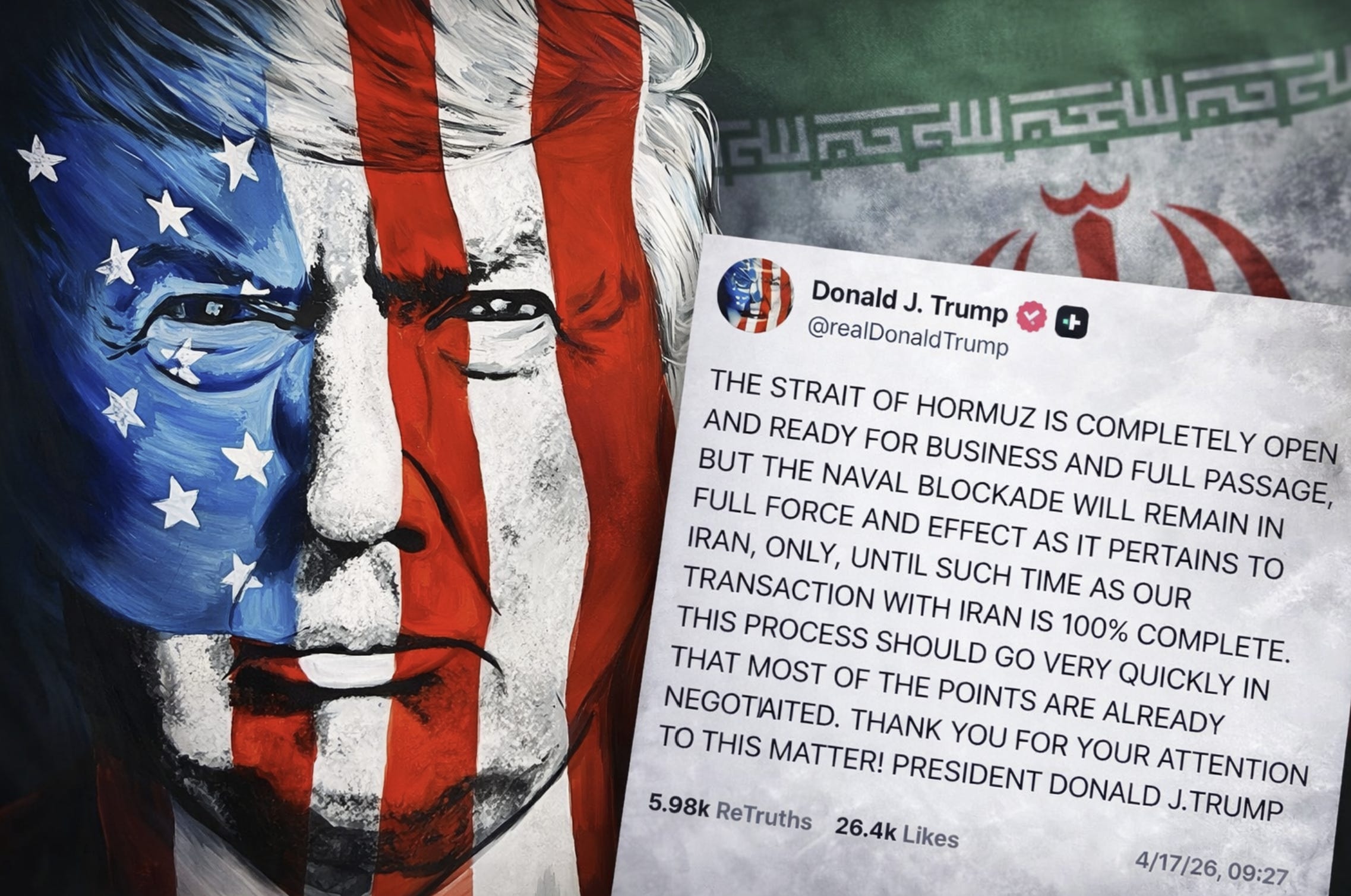
A pair of short social media posts sparked a political storm in Iran. Donald Trump presented the Strait of Hormuz arrangement as part of a much broader deal that he said was close to completion. Abbas Araghchi, Iran’s foreign minister, described something narrower and more conditional. Trump said “the Strait of Hormuz is completely open and ready for business and full passage”, while the naval blockade against Iran would remain in force until the US “transaction with Iran” was “100% complete”, adding that “most of the points are already negotiated”. Araghchi said that, “in line with the ceasefire in Lebanon”, passage for “all commercial vessels” through the Strait of Hormuz was open only for the remaining period of the ceasefire, and only on the route already announced by Iran’s Ports and Maritime Organization. Trump later went much further. In a phone interview with CBS News, he said Iran had “agreed to everything” and would work with Washington to recover its buried stockpile of highly enriched uranium, which he said would then be taken to the United States.

That confusion deepened when Iranian outlets close to the IRGC began offering their own explanations. Tasnim, citing an unnamed source close to the Supreme National Security Council, said the arrangement was part of a two-week ceasefire framework between Iran and the United States, mediated by Pakistan. According to that account, Iran had initially agreed to allow a limited number of ships to pass each day, but then suspended the arrangement after the ceasefire was not implemented in Lebanon and was not extended to Hezbollah and Israel. Tasnim’s source said Iran had set three conditions: the vessels had to be commercial, not military; neither the ships nor their cargo could be linked to hostile states; they had to use the route designated by Iran; and transit had to be coordinated with Iranian forces. The source added that if the naval blockade continued, Iran would treat that as a violation of the ceasefire and close the route again.


Tasnim then turned its criticism on Araghchi himself. It called his tweet “bad and incomplete” and said it had created unnecessary ambiguity because it did not explain the conditions, the mechanism of passage, or the role of Iran’s armed forces. Fars made the same complaint in even plainer language. Its argument was not that officials should publish every detail of the talks. It was that if they believed the details could not be disclosed, they should at least explain why they were staying silent. As Fars put it, even “not explaining” now needed an explanation.

Another source of confusion was the changing Iranian account of the arrangement itself. Seyed Mahmoud Nabavian, a Tehran MP who had traveled to Pakistan with the negotiating team, said that after the United States had retreated and accepted a ceasefire in Lebanon, “some commercial ships” would be allowed through the Strait of Hormuz, and that charges would be taken from them.

But that detail disappeared from the later IRGC line. The IRGC’s message was stricter: a “new order” now governed the Strait; non-military vessels could pass only on Iran’s designated route; military vessels remained banned; all passage required permission from the IRGC Navy; and the arrangement was tied to a “period of silence on the battlefield” and to the implementation of the Lebanon ceasefire.

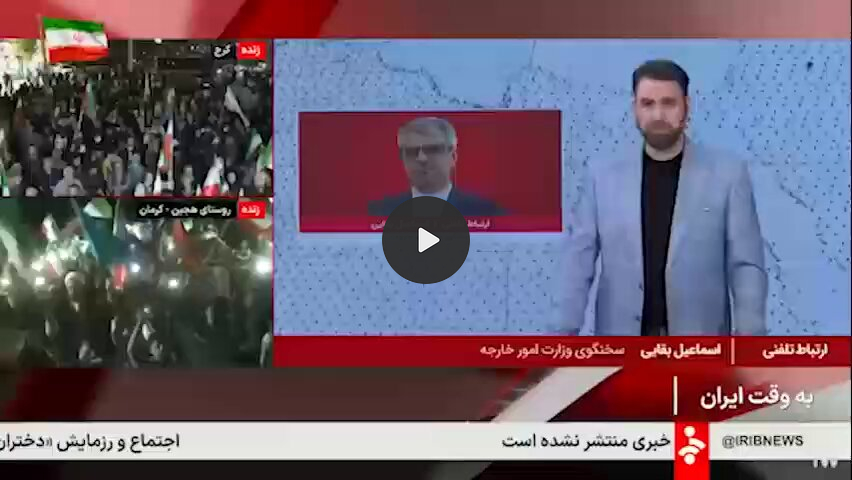
Iran’s foreign ministry spokesperson later tried to draw a firmer official line in a live interview on state TV. He said ship traffic through the Strait of Hormuz would take place only on the route set by Iran and in coordination with the relevant Iranian authorities. He told the media and the public not to pay attention to the other side’s media narrative. He also said Iran was the guardian of the Strait of Hormuz and would show no leniency in carrying out measures that protect the interests and rights of the Iranian people. In the same appearance, he said Iran had held no talks about extending the ceasefire and that, in cooperation with Pakistan, its full focus was on creating the conditions for a complete end to the war in a way that protected Iran’s interests and rights.

The criticism did not come only from Tasnim and Fars. It also spread across pro-system and conservative accounts on X. Seyed Nezamoddin Mousavi, former editor-in-chief of Fars News Agency, wrote that while Trump and his media were shaping the narrative in real time, the Iranian side was offering almost no clear or credible account of its own. He added that trusting the negotiators did not mean ignoring public opinion, and ended with a direct appeal: “Gentlemen, say something. Images of defeat and victory are made by these very narratives.”

From the other side of the political spectrum, Ali Asghar Shafieian, an adviser to the Iranian president, made a similar point. He wrote that in any agreement both sides would present their own gains: Iran has victories, America also has victories, and no side should be expected to make the other’s case for it. But he said what mattered for Iran was to tell the story of its own gains clearly.

Hardline voices focused directly on Araghchi’s wording. Seyed Morteza Mahmoudi, a Tehran MP, wrote that if there had not been a war, Araghchi would certainly have been impeached over his tweet. He accused the foreign minister of once again making ill-timed remarks at a highly sensitive moment and, in effect, helping to calm global oil and energy markets.


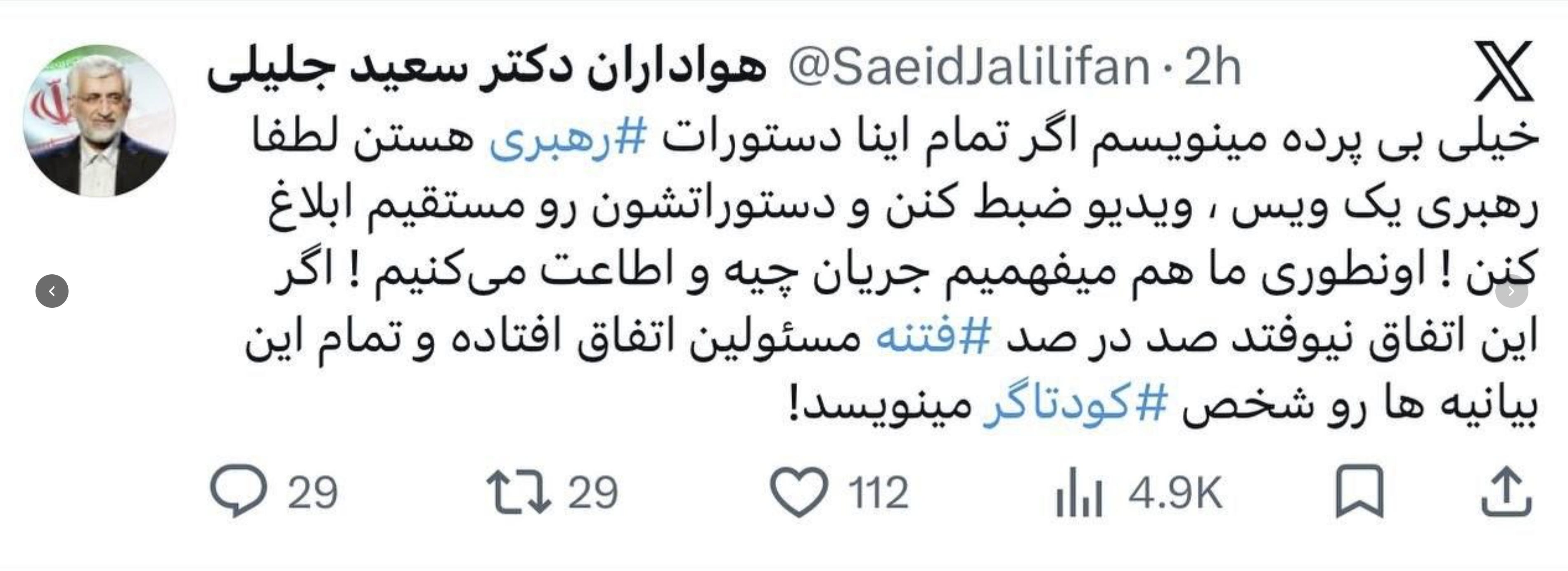
A page presenting itself as a Saeed Jalili fan account wrote that if these really were the Supreme Leader’s instructions, he should announce them himself in a recorded audio or video message so people would know what was going on and follow them. It said that if no such direct message appeared, then the whole thing was clearly being driven by officials, and that the public statements were being written by what it called a “coup plotter.”
Jalili, a former nuclear negotiator and former secretary of the Supreme National Security Council, is one of the Islamic Republic’s best-known hardline figures and is widely associated with opposition to compromise with the West. The page was widely seen as close to Jalili’s political camp. After the post appeared, the account was taken down.
At the same time, some loyalist voices tried to restore message discipline. Seyed Abbas Mousavi, Chief of Protocol in the Iranian President’s Office, wrote that despite Trump’s bluster and misleading claims, the reality was different: the ceasefire in Lebanon had been imposed on the enemy under heavy pressure, and the Strait of Hormuz remained under Iran’s control and would continue to be managed on Iran’s terms.


Taken together, these statements explain why the confusion spread so quickly. Trump spoke as if a broad deal was close. Araghchi described a narrower, conditional arrangement. Tasnim said it was limited and reversible. The IRGC stressed that all movement remained under Iranian military control. The foreign ministry spokesperson said there had been no talks on extending the ceasefire. Even pro-system commentators began asking why the Iranian side was not giving a clear account of what had actually been agreed. The issue, in the end, was not only secrecy. It was the failure to present a coherent Iranian narrative before Trump defined the story himself.
In a single post on his own platform, Trump triggered a political storm inside Iran.
Here’s a simpler explanation. The Iranian regime is near collapse and are losing control. The U.S. and Israel hold the keys to Iran’s post-Islamic Republic future. There is nothing the IRGC can do about the U.S. counter-blockade which the IRGC brought upon itself by its deliberate breach of international law in closing a free passage waterway.
Now, just as the UK did with its blockade of Germany in WWII, the counter-blockade will continue until the Iranian regime agrees to the U.S. terms left on the table by VP Vance.
As the presumed descendants of the inventors of chess, when you are in a checkmate position, there is only one option.
This is just pure chaos in the fragmented remnents of Iran's government. As noted, Trump has all the cards and the blockade is the final turn of the screw.