


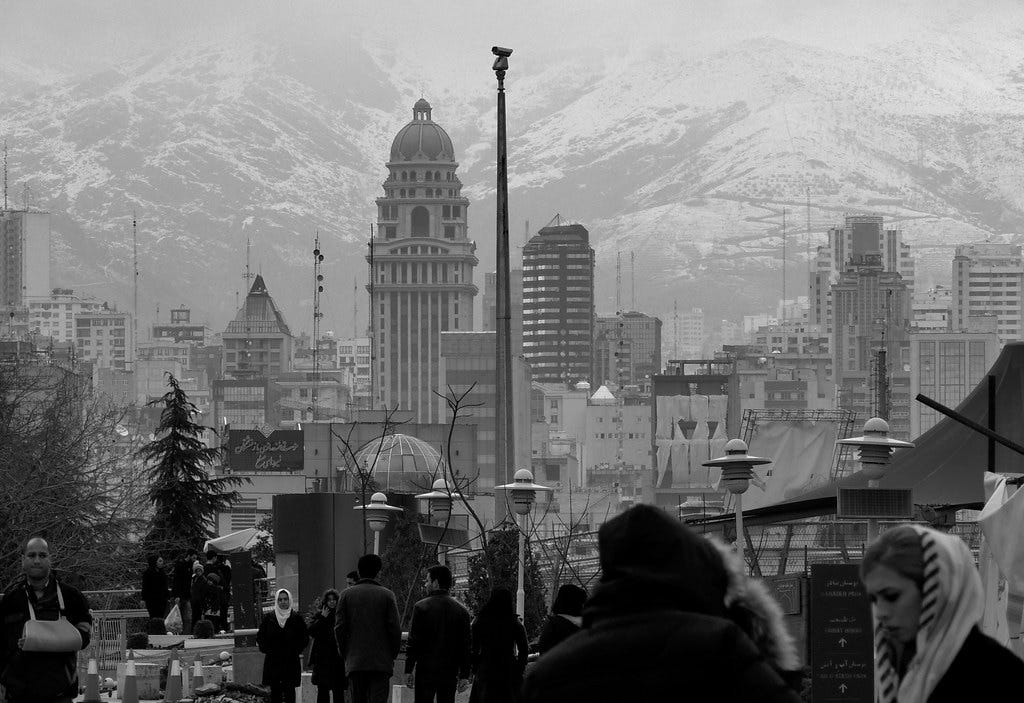
Iran isn’t misunderstood because it’s mysterious. It’s misunderstood because it’s filtered.
On January 8 and 9, the IRGC and Basij carried out a nationwide killing operation. Security forces opened fire across multiple cities. In roughly forty eight hours, thousands of civilians were dead. Some estimates put the toll between 30,000 and 40,000. Bodies were removed quickly. The country went into an internet blackout. The state moved to control what could be seen, counted, and said.
The scale stunned much of the West. Commentators questioned the numbers and asked how a government could do this to its own people. For many, the massacre did not fit the Iran they thought they understood.
But it fit the Islamic Republic. A system built on ideological absolutism, coercion, and impunity does not moderate when it feels threatened. It escalates into brutality. What should trouble Western institutions is not only what happened, but why it still felt unbelievable.
For decades, a stubborn pattern has run through Western journalism, academia, and think tanks: a drift toward normalizing the Islamic Republic.
Not understanding it. Normalizing it.
Normalization is not a conclusion reached. It is a result produced. It is built through methods that look like seriousness itself: verification standards that become paralysis, balance that becomes false symmetry, caution that becomes euphemism, and access that becomes discipline. The result is rarely fabrication. It is something more durable, an ecosystem in which blunt description is treated as reckless, while the regime’s preferred framing can pass as sober analysis.
“In Western discourse, restraint and balance often blurred into a refusal to name what the Islamic Republic actually is.”
This piece maps how that ecosystem works. Not as a conspiracy, and not as a claim that Western work on Iran is uniformly flawed. Much of it is careful and indispensable. The problem is more specific and more repeatable: the same institutional defaults and interpretive shortcuts keep recurring across outlets and political moments, producing misreadings that are often wrong in the same direction.
What follows is a map of those moves. I call them filters. Each filter can look reasonable on its own. Many exist for real reasons: rigor, skepticism, and a desire to avoid being manipulated. The problem is what happens when they operate asymmetrically, or become professional reflexes that outlive the reality they were meant to describe.
Together, they create an interpretive environment that drifts away from lived reality while still sounding responsible. They shape who gets rewarded, who gets treated as credible, what access is worth, what language is permitted, and which truths get softened into respectable doubt.
“What reads as analysis in the West decides who is believed, who is ignored, which policies get made, and who pays the price in Iran, often with their lives.”
The goal here is not a policy prescription. It is a field guide to how description becomes assumption, and how assumption becomes policy. For analysts, this is a profession. Iran is a subject of study. For Iranians, it is life. And what is written in the West does not stay on paper. It becomes permission, pressure, policy, and consequences.
Here are the filters.
The filters
I’m laying these out in the sequence that makes the pattern make sense.
Incentive
Credibility
Institutional Mirage
Access
Supervised Reality
Mechanical Balance
Euphemism
The Iraq Shadow
Conspiracy
Hallucination
Each filter is small on its own. Together, they rewrite reality.
1) The incentive filter: conformity as a career strategy
Conformity exists everywhere. It becomes corrosive when verification is hard, access is controlled, the stakes are high, and the subject is politically radioactive. That is Iran.
In that environment, career reward fit.
If you want a PhD, you learn what supervisors will approve.
If you want to publish, you learn what editors will accept.
If you want invitations and funding, you learn what will not get you labeled “extreme.”
If you want institutional trust, you learn which tone counts as “responsible.”
This is not always censorship. It is sorting.
“In Iran work, career safety can shape what gets written before truth ever gets tested.”
Arguments that describe the Islamic Republic as structurally unreformable rarely die by factual rebuttal. More often, they are trimmed by procedure and tone. “Too strong.” “Too certain.” “Too activist.” The conclusion survives only after being softened into possibility and buried under qualifiers.
Over time, a canon forms. Frameworks that are safe circulate long after they stop matching the country on the ground. Analysis becomes a professional routine. Reality gets forced to fit.
2) The credibility filter: how reassurance becomes authority
The incentive filter shapes what gets produced. The credibility filter shapes what gets heard.
Before policy is debated or headlines are written, credibility does its sorting. Editors, producers, and institutions gravitate toward voices that sound “measured”, “de-escalatory”, and “reassuring”. Not because they are corrupt, but because reassurance reads as responsibility.
“Professional credibility in Iran coverage is often built on tone rather than accuracy.”
Over time, “serious” becomes a tone rather than a standard of accuracy. Messages framed as moderation, internal balance, and gradual change travel further. Diagnoses framed as rupture, exhaustion of reform, or structural dead ends are treated as risky.
This is how narratives align with the regime’s preferred framing without anyone taking orders. A claim delivered in the accent of professionalism passes through gates with less friction. It becomes the baseline of debate.
Safety becomes authority. Authority becomes the lens.
3) The institutional-mirage filter: familiar labels, different system
No serious Western journalist thinks the Islamic Republic is a normal democracy. The problem is subtler. Iran uses familiar institutional labels that quietly import Western assumptions about how power works. President, parliament, judiciary, election, media. The words sound familiar, so outsiders apply familiar logic: separation of powers, real competition, accountability, and consequences.
Knowing that Iran is not the West does not cancel the reflex to project. We understand unfamiliar systems by analogy, and Iran’s borrowed political vocabulary invites exactly that move. The West knows Iran is not a democracy, yet it repeatedly remakes Iran in its own image.
In Iran, the names are familiar. The functions are not. That mismatch produces a predictable error. Managed competition is mistaken for genuine competition, and symbolic politics are read as real leverage.
Coverage then defaults to a comfortable script: moderates versus hardliners, reformists versus conservatives. At first, this looks like a harmless way to describe factional rivalry. Over time, it becomes more than shorthand. It turns into a master key for explaining nearly everything Iran does, even when the decisive choices are made outside the electoral arena.
“The Islamic Republic doesn’t just sell narratives. It sells institutional resemblance.”
Factions are real. Rivalries exist. But the factional frame is asked to explain outcomes that are not factional. In the Islamic Republic, the center of gravity does not move with ballots.
That’s why elections are such a trap for outside observers. Each cycle is treated as a pivot point, as if the vote itself determines strategic direction. At most, elections change tone and tactics. They do not change who holds the levers.
On the issues that define Iran’s trajectory, the president does not control the nuclear file. He, always he, does not control the Islamic Revolutionary Guard Corps. He does not control the regional network. He does not control the core security state. He operates inside red lines drawn by the Supreme Leader and enforced by parallel, unelected centers of power.
“Managed politics is treated as real politics.”
It is true that Iran can look different under different presidents. But those differences do not arise simply because one man was “elected.” Often, causality runs the other way: strategic decisions are made at the top, and then the political field is shaped to fit those decisions.
That is why interviews with Iranian presidents and senior officials are so often overrated. In the West, a president can lie and pay for it with voters, investigations, and institutional consequences. In Iran, voters lack that agency, and the institutions that would punish deception are part of the same system. A tough interview may produce viral moments, but it rarely produces accountability. This is what makes the scramble by Western outlets to secure these sit-downs so misplaced. The interview is treated as a journalistic prize, while the regime walks away with the prestige and the platform.
The Islamic Republic does not rely solely on propaganda. It uses institutional resemblance. It borrows familiar words to trigger familiar assumptions. And if you cover Iran through those assumptions, you will keep mistaking the appearance of a state for the reality of a system.
4) The access filter: permission as leverage
Access in Iran is not just a temptation. It is a weapon.
Tehran does not only control what can be said inside the country. It controls who is allowed to see the country in the first place. That permission then travels back to Western newsrooms, universities, and institutions as a form of credibility. Access becomes a stamp of seriousness. And once access becomes status, the regime can shape what is produced without issuing orders, simply by opening and closing the gate.
A longtime British broadcaster once described his outlet’s relationship with Tehran in a single sentence. Asked how they secured such easy access, he paused and replied, “They whistle, and we go.”
“In Iran, access is not evidence. It is a permission slip, and permission is granted for a reason.”
That line captures the inversion. Tehran grants permission, and foreign institutions treat permission as legitimacy. The hunger for proximity does the rest. The regime does not need to script every sentence. It only needs to control the conditions under which knowledge is gathered.
I saw how this works inside a major international broadcaster that kept a resident correspondent in Tehran. When sensitive reporting was being prepared elsewhere in the organization, concerns would surface from Tehran that crossing certain lines could jeopardize the visa required to remain in the country. No explicit order was given. No editor said “kill the story.” The leverage did not need to be spoken. Everyone understood the implication. A regime-controlled visa was shaping decisions far beyond Iran’s borders.
Read that carefully. A visa can discipline journalism outside Iran. Tehran does not need to call editors abroad. It only needs someone inside Iran to fear consequences, and that fear travels outward into editorial decisions. For years, major outlets operated under this logic. Everyone knew there were lines you could not cross if you wanted to stay.
“When a regime controls the door, it does not have to control every sentence. The fear of losing entry will do the editing.”
After the 2009 election crisis, Tehran expelled most resident correspondents. The mechanism did not disappear. It evolved. Instead of permanent access, the regime shifted to selective access: visas granted for elections, staged visits, and major events, on Tehran’s terms, to chosen reporters, when it wanted a narrative reset. Tehran decided which moment would be covered and who would be allowed in.
The discipline did not end. It spread. Journalists learned how to behave if they wanted to get in next time. Their access-conditioned reporting became raw material for analysts and think tank papers, then entered academic work and hardened into the record. What begins as a visa decision can become a policy assumption.
The same structure operates in academia, and it is just as corrosive.
Professors need promotion. They need grants, publications, invitations, and institutional status. In many universities, “serious” Iran work is expected to look sourced, inside, and connected to officials and sanctioned access. So certain scholars travel to Iran. They meet officials. They conduct interviews. They return to their campuses and turn those encounters into peer-reviewed papers, books, and policy-facing research.
In the West, access becomes a credential. Iran does not allow every professor to enter. Tehran controls the gate, and the scholar who gets in can claim something others cannot: I was there. I spoke to people in power. That credential moves him up the hierarchy.
“A visa is not just a travel document. It is a lever that reaches into foreign newsrooms, campuses, and careers.”
But access is never free. Continued access is the currency. The next trip depends on the last paper. Scholars learn, quickly, that their work must remain within lines that allow them to return. No one needs to hand them a written list. The boundaries are enforced through permission and denial.
The ritual repeats. A courteous conversation in a hotel lobby, where everyone understands the limits without needing them stated. A meeting arranged through intermediaries. An interview conducted under conditions no one pretends are neutral. Security officials do not need to issue explicit instructions because the incentives have already done the training. Over time, this becomes routine. It becomes normal. It becomes an accepted route to producing “authoritative” knowledge about Iran.
The result is predictable. A body of reporting and scholarship stays inside a framework the Islamic Republic can tolerate, because status depends on access and access depends on staying tolerable.
What gets produced is not knowledge of Iran as it is. It is an access-conditioned Iran, built to survive the next visit. A paper Iran that can be cited, promoted, and rewarded, yet has little relation to reality on the ground.
5) The supervised-reality filter: “reporting from Tehran” as stagecraft
Access is the gate. Supervision is the price of entry.
The fixer is not simply a translator or logistical aide. In practice, the fixer functions as a minder. They shape where a visitor can go, whom they can meet, what they can film, what they can ask, and what they are expected not to notice. This control is rarely explicit. It operates through constraints.
That is why physical presence in Iran can reveal less than distance reporting. Being there comes with choreography. Movement is guided. Access is staged. What appears to be a firsthand observation is often a preselected experience.
“In Iran, ‘on the ground’ means on a set.”
After major “crackdowns”, the pattern becomes especially clear. Access is denied while evidence is raw and uncontrollable. Then, once the scene is cleaned and the narrative prepared, access is granted for a managed visit. Reporters are guided through rehearsed locations and introduced to handpicked voices ready to deliver the state’s version of events. The reporting looks like eyewitness journalism, but the ground has been prepared in advance.
The state does not need observers to lie. It only needs to decide what they are allowed to see.
That is how stagecraft becomes “on the ground.”
6) The mechanical-balance filter: how the regime’s claims get a free ride
One of the most damaging routines in institutional Iran coverage is mechanical balance. It turns “fairness” into a machine that produces distortion.
Victims’ accounts arrive wrapped in doubt.
“We cannot independently verify.”
“These claims are unconfirmed.”
“It is difficult to authenticate.”
But the regime’s line often goes out clean, is quoted confidently, and is treated as the baseline.
Editors assume the audience “understands.” They don’t. When one side is drenched in disclaimers, and the other is delivered as authoritative, the result is not balance. It is built in advantage.
“When one side gets caveats and the other gets a microphone, ‘balance’ becomes distortion.”
Casualty reporting shows the pattern. Citizen videos, hospital lists, and eyewitness accounts are presented as claims that cannot be verified, and the caveat is placed up front. Then the state’s number is quoted as a clean fact, with skepticism buried later, if at all, even though the state has every incentive to minimize.
The state narrative sounds solid.
The citizen narrative sounds questionable.
The truth is diluted.
That isn’t neutral reporting. It is geometry that favors the state.
7) The euphemism filter: sanitizing brutality
Language does not merely describe violence. It can neutralize it. In Iran coverage, euphemism often replaces clarity.
People are not shot; there are “clashes.”
Hostages are not hostages; they are “detained dual nationals.”
Terror is not terror; it is “pressure.”
Mass killing is not mass killing; it is “a crackdown.”
Torture is not torture; it is “mistreatment” or “allegations of abuse.”
This is not just a vocabulary problem. It is a moral and analytical distortion. Euphemism lowers the temperature of reality. It turns deliberate state violence into an event that simply happened, stripped of agency and intent.
“Euphemism turns brutality into bureaucracy.”
A reader hears “clashes” and imagines symmetry. But the symmetry is false. One side is a state with guns, prisons, and impunity. The other is civilians in the street who get shot. A reader hears “detained” and imagines due process. A reader hears “crackdown” and imagines baton charges, not bodies.
Euphemism does not protect neutrality. It protects the perpetrator.
By smoothing language, coverage shifts moral weight away from action and onto abstraction. Responsibility dissolves into process. Violence becomes bureaucracy, and bureaucracy is easy to tolerate.
This is how brutality is made to sound normal.
8) The Iraq shadow filter: fear masquerading as prudence
After Iraq, a rule settled into Western institutions: do not be wrong in a way that could help start another war.
The fear is understandable. It is also distorting.
In Iran debates, that fear often shifts analysis away from description and toward risk management. The question stops being “is this true?” and becomes “what might this lead to?” Language is policed not for accuracy but for its potential consequences. Moral clarity is treated as escalation. Blunt diagnosis is labeled dangerous.
“Iraq taught institutions to fear being right for the wrong consequences.”
A familiar pattern follows. Describe the Islamic Republic plainly as a system that takes hostages, funds, and directs armed proxies, and jails, tortures, and shoots its own citizens. The response is rarely a factual rebuttal. It is a warning about tone. “This framing escalates.” “This helps hawks.” “This closes diplomatic space.” The argument shifts from whether it is true to whether it is safe to say.
The intention is to prevent catastrophe. The effect is to dull analysis.
Prudence in action can be wise. Prudence in description can become distortion. When fear of repeating Iraq governs how Iran is described, institutions struggle to say plainly what Iran is doing, even when the evidence is overwhelming.
The result is a discourse in which accuracy is treated as a liability and caution is mistaken for rigor. Not because the facts are unclear, but because the imagined consequences of stating them feel too dangerous to risk.
9) The conspiracy filter: deleting Iranian agency
A stubborn reflex lingers from the Cold War. When people rise up in an anti-Western state, the explanation must lie elsewhere. If crowds protest, the CIA must be orchestrating them. If an opposition figure gains traction, he must be “foreign-backed.” If unrest spreads, it must be a plot.
This reflex is analytically lazy and morally corrosive. It strips people of agency and echoes the regime’s own line that dissent is imported. The question stops being why Iranians are risking their lives and becomes who must be pulling the strings.
“In hostile regimes, popular dissent is rarely allowed to be popular. It must belong to someone.”
The vocabulary reveals the move. Protests are “orchestrated.” Strikes are “infiltrated.” Grassroots mobilization is “engineered.” The emphasis shifts from grievances to suspicion, from lived reality to imagined puppeteers.
Iran does not need conspiracies to explain mass dissent. A state that jails, tortures, and shoots its own citizens generates resistance on its own. Treating that resistance as foreign manipulation does not explain Iran. It explains the reluctance to accept that Iranians are acting in their own interests.
By deleting Iranian agency, this filter turns a society into an object. And once people are reduced to objects, their choices, courage, and costs become easy to dismiss.
10) The hallucination filter: self-confirming expertise
Now we reach the core failure, the one that makes misreading durable.
We talk a lot about hallucinations in AI: a system generates a world that appears coherent, cites itself, and sounds confident while drifting further from reality. Professional ecosystems can hallucinate, too.
The body of Western expertise on Iran looks vast. Thousands of reports, papers, books, and briefings circulate under the banner of seriousness every year. But much of this volume compresses into a relatively small canon of shared assumptions, repeated frameworks, and familiar conclusions. The citations multiply. The underlying ideas do not.
We read the existing literature and write within it. We absorb the approved vocabulary, the respectable framing, the safe conclusions. The work looks new, but it often reproduces the same architecture. Heavily footnoted, it feels solid.
“Citation density is mistaken for contact with reality.”
This is how “Iran in the West” gets built. Papers cite papers. Reports cite reports. Panels cite journalists. Journalists cite panels. Everyone looks credentialed. Everyone sounds reasonable. The density of references creates the illusion of verification.
Over time, the ecosystem becomes self-confirming. It stops testing reality and starts protecting its own coherence. Signals from inside Iran that contradict the framework get downgraded as anecdotal, emotional, or unverified, while the consensus narrative is treated as knowledge.
And like an AI hallucination, it is hard to correct from the inside. The incentives reward coherence more than accuracy, repetition more than contradiction, staying inside the frame more than questioning whether the frame still fits the country.
So the same errors survive decade after decade. Not because Iran is unknowable, but because the knowledge machine keeps generating a version of Iran that is stable, citeable, and professionally safe, even when it is wrong.
“The Iran presented as knowledge is a product of the loop, not the country itself.”
The ecosystem doesn’t just misunderstand Iran. It misunderstands its own ignorance. It mistakes citation density for contact with reality. So when Iran behaves like Iran, institutions react the same way every time: confusion, disbelief, and a rush to reject inconvenient evidence and force events back into the framework they already trust. The Iran they know is a product of the loop, not the country.
When filters become policy
These filters do not remain confined to language, framing, or professional debate. Over time, they shape what journalists, researchers, and scholars consider plausible and what policymakers consider realistic. The filtered version of Iran becomes the Iran against which decisions are made.
This is how analysis quietly turns into assumption.
When normalization dominates interpretation, policy inherits its blind spots. Violence is treated as signaling. Escalation is read as bargaining. Ideology is translated into interests. Each move sounds analytical. Together, they produce strategies built on misrecognition.
The Iran deal era showed the cost. Much of the discourse treated the JCPOA as the beginning of transformation: integration, moderation, and a regime that would evolve as incentives accumulated. That story was built on a familiar Western assumption that economic opportunity changes political behavior.
“Bad models don’t just mislead analysis. They shape decisions.”
In Tehran, the calculation is reversed. Openness is not only money. It is exposure, social pressure, and loss of control. So the system accepts relief tactically while insulating the core, and it rejects or hollows out offers that the West assumes are irresistible.
That is what it means to negotiate with a filtered Iran. Pressure eases, resources flow, and outsiders tell themselves they are empowering change, while the system adapts and hardens. Then the same institutions act surprised when the “opening” fails to open.
So what now?
The Islamic Republic maintains itself through systematic killing, imprisonment, deception, and coercion. If the West cannot say that plainly, it becomes part of the problem.
The basic test is simple:
Are we describing Iran as it is, or as it is safe to describe?
Are we loyal to reality, or loyal to the consequences of stating reality in Western politics?
Are we observing Iranian society, or projecting Western debates onto it?
Are we treating Iranians as authors of their history, or as objects moved by others?
Are we using balance and restraint to clarify, or to blur?
Are we updating our framework when reality contradicts it, or protecting the framework?
Iran is not impossible to understand. But understanding requires dropping the filters that make misunderstanding feel responsible.
Until that happens, the cycle will continue. Credentialed narratives, comfortable frameworks, and surprise when Iran refuses to play the role assigned to it.
Drop the filters, or keep being surprised.
Thank you for this excellent analysis. Your “filter” system can be applied to other governments hiding behind their lies, deceit and manipulations. Your piece helps to explain Iran. I hope our U.S. policy analysts are familiar with your insight—they should be. Please continue helping us understand Iran. We hope change is coming for the people who have endured this corrupt theocracy for so long.
Thank you. An very interesting analysis. I kept thinking how much of it applied to the Israeli regime.